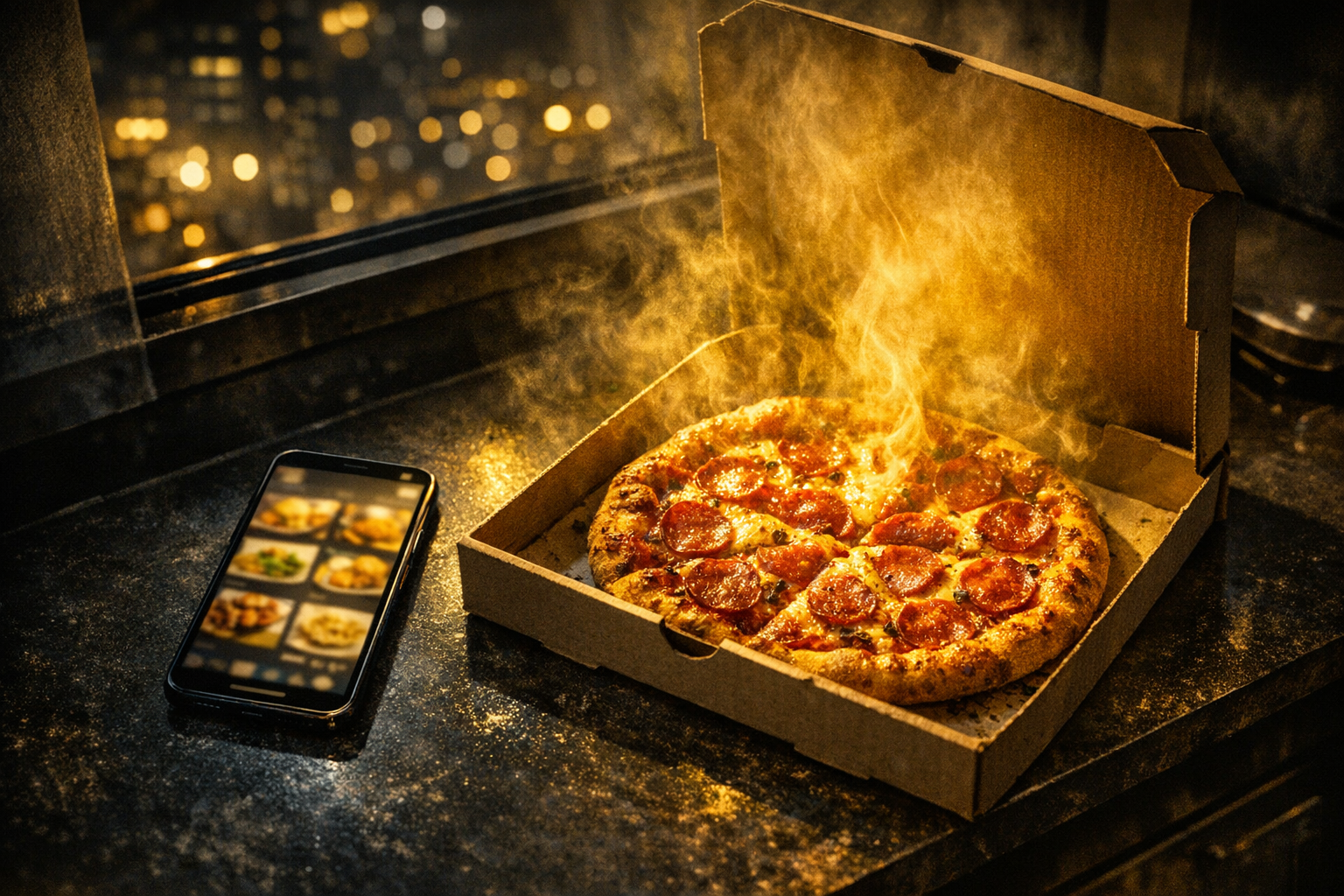
Among all the foods available for urban delivery, pizza has maintained its position at the top of the popularity charts for decades. This isn't just habit or marketing — there are genuine structural, practical, and culinary reasons why pizza consistently outperforms other foods when it comes to quick, reliable delivery. From its heat retention properties to its structural integrity during transit, pizza is engineered by circumstance and refinement to travel well.
The Physics of Pizza Delivery
Pizza has an unusually favorable surface-area-to-volume ratio for a cooked food. The wide, flat geometry of a baked pizza base loses heat more slowly than foods with compact, dense structures — particularly when housed in an insulated box that traps steam and ambient heat. This means that a pizza removed from a 500°F oven and placed in a quality delivery box maintains an acceptable eating temperature for 20–30 minutes, which precisely overlaps with the typical urban delivery window.
Compare this to pasta, which separates and cools rapidly; or to fried foods, which lose their textural appeal within minutes of being removed from hot oil. Pizza's resistance to quality degradation during a standard delivery window is genuinely remarkable among cooked foods.
Structural Integrity in Transit
The physics of pizza extend to its structural behavior during transport. A properly baked pizza — especially thin or medium crust varieties — maintains its form during a delivery run in ways that other foods cannot. It doesn't shift, collapse, or become unrecognizable during the jolts and vibrations of urban transit. The cheese and toppings, melted into a cohesive layer during baking, hold their position rather than sliding or separating.
This structural reliability is a key reason that delivery-focused pizzerias can operate with confidence in quality consistency. The kitchen knows that a pizza emerging from the oven will arrive at the customer's door in a recognizable, appealing state — which cannot be said for more delicate dishes like soufflés, certain pasta preparations, or dishes with separated sauce components.
The Box: An Engineering Marvel
It's worth giving appropriate credit to the pizza delivery box — an often overlooked but genuinely clever piece of packaging engineering. The corrugated cardboard construction provides thermal insulation while the vented top releases excess steam that would otherwise make the crust soggy. The flat, rigid base provides a stable surface for stacking and transport. The friction-fit closure keeps the box secure during movement without requiring tape or adhesive.
This packaging system, which has remained largely unchanged in its fundamental design for decades, is specifically optimized for the delivery journey. It's so effective at its job that most food delivery packaging innovations in other categories have attempted to replicate aspects of the pizza box's approach.
Preparation Time Advantages
From the kitchen perspective, pizza has significant preparation time advantages over many competing delivery foods. A thin-crust pizza can go from raw dough to fully baked in 8–12 minutes. The preparation is largely linear — stretch, sauce, top, bake — without multiple parallel cooking processes or complex timing dependencies.
This linearity makes pizza preparation highly scalable and predictable. A busy Friday night kitchen can process 30–40 pizza orders in the same time window that a comparable kitchen might manage 15–20 complex multi-component dishes. This throughput efficiency directly translates to shorter customer wait times, making pizza inherently faster to deliver than most alternatives.
The Versatility Factor
Pizza's ability to accommodate an almost unlimited range of toppings and variations without changing its fundamental delivery characteristics is another key advantage. Whether you're ordering a simple margherita or a complex 8-topping creation, the delivery experience follows the same predictable pattern. The kitchen process, packaging, and transport requirements don't change meaningfully based on what's on top of the pie.
This versatility means that a single delivery-focused pizzeria can serve an enormous range of customer preferences — dietary restrictions, flavor preferences, cultural influences — without the operational complexity that this range would create in other food categories. The result is a restaurant model that scales delivery operations efficiently while maintaining variety for customers.
Cultural and Psychological Factors
Beyond the purely physical and operational reasons, pizza has cultural advantages in the delivery context. It's a universally recognized, deeply familiar food with cross-demographic appeal. When you order pizza for a group, you rarely need to worry about whether everyone will find something they like. This psychological simplicity — the absence of decision fatigue and the reliability of broad satisfaction — makes pizza the default delivery choice in countless situations where other options might be technically available.
There's also the satisfaction dimension. Pizza is one of the few foods that people report enjoying nearly as much from delivery as from in-restaurant dining. The gap between "restaurant experience" and "delivery experience" is smaller for pizza than for almost any other cuisine. This is partly physical (heat retention, structural integrity) and partly psychological (expectation alignment — pizza is expected to be a casual, no-fuss experience).
San Francisco's Specific Pizza Delivery Advantages
In the San Francisco context specifically, pizza delivery benefits from several additional factors. The city's density means that most SF residents are within a 1–2 mile radius of multiple quality pizzerias. This compressed geography makes the "last mile" of delivery exceptionally short and fast compared to suburban or rural contexts. E-bikes and scooters, which dominate SF delivery, can navigate the city's hills and traffic patterns faster than cars for these short distances.
The city's tech-forward culture has also contributed to a particularly sophisticated pizza delivery infrastructure. Real-time order tracking, optimized dispatch algorithms, and app-based ordering have all been refined in SF's demanding market — and pizza delivery has benefited disproportionately, given its high order volume and predictable operational requirements.
Conclusion: Pizza's Delivery Dominance Is Earned
Pizza's position as the dominant delivery food isn't accidental or arbitrary. It's the result of a convergence of physical properties, operational characteristics, packaging innovation, and cultural resonance that together create a near-ideal delivery food. Understanding why pizza travels so well — and why ordering it tends to produce consistent, satisfying results — helps you make smarter delivery choices and set accurate expectations for your meal.
Whether you're ordering a quick thin-crust pie after a long workday or a premium gourmet individual pizza for a special solo evening, the fundamental advantages that make pizza great for delivery are working in your favor every time you place an order.